

2025 | Subtext Artistic Research Fellowships | Rough Edges
Subtext Artistic Research Fellowships
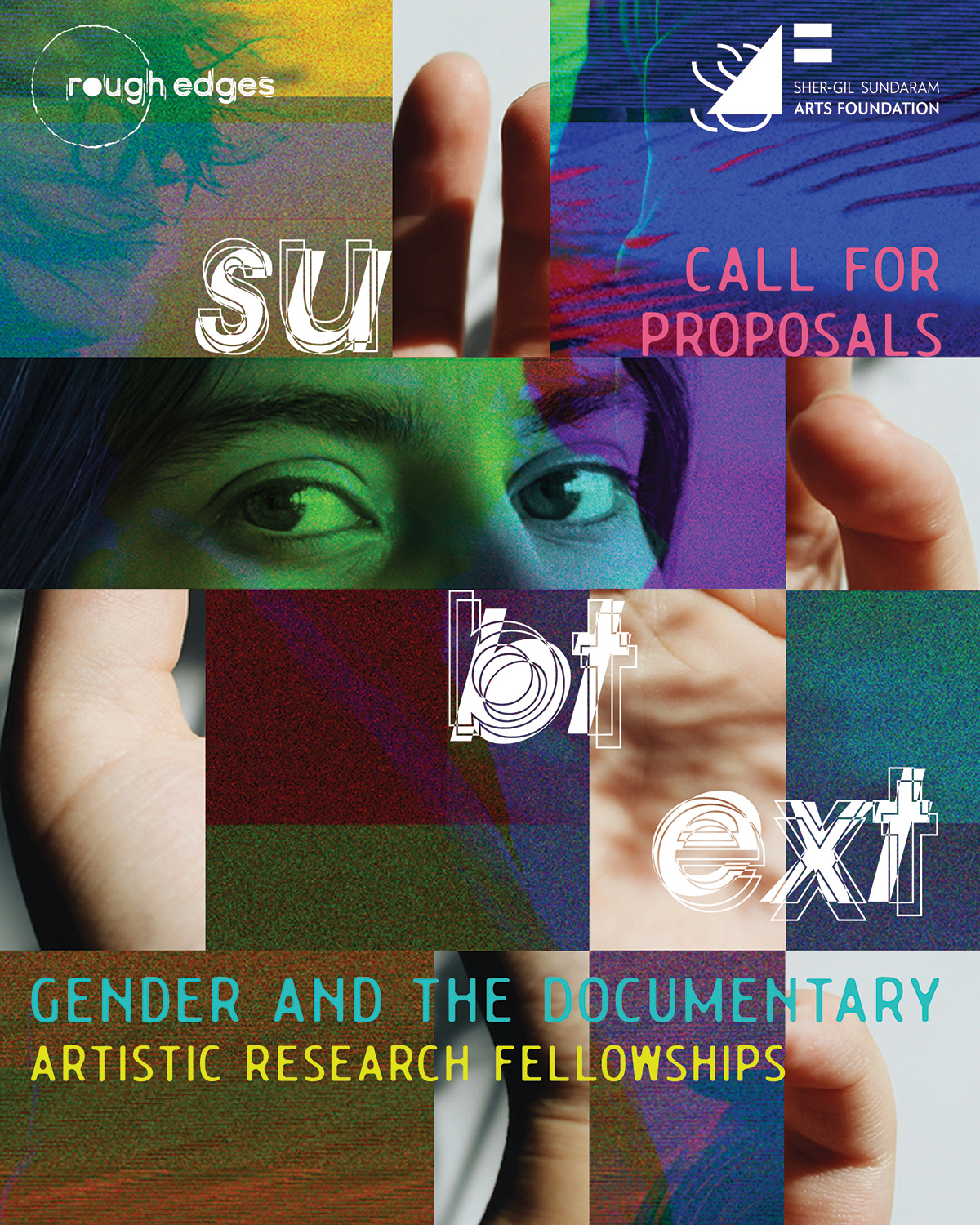
Rough Edges, with support from the Sher-Gil SundaramArts Foundation, has instituted Subtext Artistic Research Fellowships to facilitate in-depth and insightful explorations of myriad complex and intimate relationships and connections between gendered realities and varied forms of documentary film practice, storytelling, politics, histories and spectatorship.
Open to women, trans and queer researchers, artists and practitioners, resident in India, as individuals, teams and collectives, these fellowships will involve research, enquiry, analysis and the creation of varied artistic material around the Indian documentary, from diverse locations. Given the nature and impetus of these projects, the outcomes would be as much about the making of new pieces and forms that amalgamate archival and original material, as offering critique, readings and commentaries on existing films and practices.
Four fellowships were to be awarded in the first iteration of the Fellowships. However, five fellows and projects have been selected for commissioning, who will research and create their projects with the support and mentorship of Rough Edges, over six months, starting mid-February 2026.
Selected Projects & Fellows
1. Glances and Stares: Reading Infrastructure in the Documentary Gaze
Long-form Critical Creative Essay with Mixed-Media Integration
Ansh (Qabeer) Sharma
About the project
Anindya Shankar Das’ Zara Nazar Utha ke Dekho begins with a provocation: “How do LGBTQ people recognise and approach each other? How do they communicate desire?” This mixed-media essay, deliberately putting the film in a ‘messy’ dialogue with ethnographic encounters and archival fragments, explores how ‘looking’ anchors cruising across film, city and archive. By ‘looking through’ the fragmented and fractured gazes of different sources, this essay attempts to offer new registers of holding onto risk, gendered labour and spectatorship in documentary practice.
About the fellow
Ansh(she/they) is a neurodivergent trans* researcher interested in discourse(s) of intimacy, infrastructure and digitality. Guided by anti-caste and crip-queer frameworks, she is passionate about collective care and institutional accountability. A postgraduate in Sociology from Dr. B.R. Ambedkar University, Delhi, they were formerly a Research Fellow at the Centre for Studies in Gender & Sexuality, Ashoka University.
2. Belonging Elsewhere: Faith, Space and Memory in Muslim Women’s Documentary Filmmaking
Video Essay
Nawa Fatima and Zoya Fatima
About the project
A video essay exploring belonging, identity and Muslim womanhood through three Delhi-based documentaries by women filmmakers, interwoven with the researchers’ memories from Bhagalpur and their independent lives in Delhi. A conversation across films, cities, generations and the shifting languages of home, searching for where Muslim women can finally belong.
About the fellows
Nawa is a PhD Research Scholar at the AJK Mass Communication Research Centre, Jamia Millia Islamia, where she is researching digital media and affect. Originally from Bhagalpur, Bihar, she has lived independently in Delhi for the past nine years. This journey between two cities has shaped her intellectual and personal commitments to questions of belonging, identity, mobility and the lived realities of Muslim women in India. Much of her work is informed by her relationship with her mother, a woman whose ambition and resilience continue to inspire her, even as generational and linguistic shifts create gaps in understanding. Nawa’s academic and creative pursuits reflect her desire to bridge these distances and to translate everyday experiences into forms that can be seen, heard, and remembered.
Zoya is pursuing her Master’s in Mass Communication at AJK MCRC, Jamia Millia Islamia. Six years younger than Nawa, she offers a generationally distinct perspective on similar experiences of growing up as a Muslim girl in a small town and later navigating life in Delhi. For over five years, she has actively expressed her voice through her YouTube channel, where she discusses her everyday encounters and concerns, using digital spaces as platforms for self-representation. Her creative practice reflects her clarity and confidence in articulating gendered experiences that often remain unspoken.
3. In-Between Archive and Memory: Women and Queer Film Practices
Creative Writing and Video Work
Oshee Johri
About the project
This project will explore the fragile archival lives and circulation networks of feminist and queer documentary films in India. Through interviews, fieldwork and creative outputs, it examines alternative preservation practices, community-led screening ecologies and the gendered labour sustaining these films, imagining more inclusive and sustainable archival futures.
About the fellow
Oshee is a filmmaker-scholar currently pursuing her Masters in Film Studies from English and Foreign Language University and is an Independent research fellow at Satyajit Ray Film & Television Institute. She worked as researcher and Director’s Assistant for Nomadsfilmschool’s F(r)ICTION Cinema Camp -1 and her film Work in Progress won the Silver Bioscope at Nagari Short Film Competition 2023. She has worked at FWI Media as production and editing assistant in Toronto, Canada, and at Emmay Entertainment, Mumbai, as a junior writer, after pursuing a Bachelor’s in Screenwriting from TISS, Whistling Woods Mumbai campus.
4. Decolonising the Documentary Gaze: Adivasi Women and Self-Representation
Creative Writing
Parul Kunkal
About the project
As an Adivasi woman and aspiring filmmaker from Jharkhand, Parul seeks to examine two tribal women filmmakers’ works -Lipika Darai (Ho tribe) and Sneha Mundari (Munda tribe). Through their documentaries and other works, she will explore how these tribal women filmmakers, standing at the intersection of gender and indigeneity, achieve self-representation from within their communities. Her work aims to subvert cinema’s dominant gaze, counter long-standing epistemic violence and centre tribal ontologies, applying decolonial theories to amplify indigenous voices and cultural truths.
About the fellow
Parul is an Adivasi woman, an aspiring filmmaker and a media student from Jharkhand, with a practice grounded in Indigenous storytelling, gender and documentary film. As a Green Hub Central India Fellow, she trained in video documentation and worked closely with tribal communities across Central India. She is currently making a documentary on an Adivasi conservationist for RoundGlass Sustain. Her work centres on self-representation, decolonial narratives and the everyday lived experiences of Adivasi women. She hopes to contribute to more nuanced and community-rooted visual cultures in India.
5. Trans-Queering the Indian Documentary Scene
Mixed-Media Installation
Rinjini Majumder
About the project
The proposed outcome will be an immersive mixed-media installation that integrates video work, audio-visual components, archival material and participatory elements, centring the representation of trans subjectivity in queer Indian documentary films. It will combine aspects of projection-based video art, sound design, interactive media and collaborative audience-generated contributions, creating a multi-sensory and non-linear exhibition experience.
About the fellow
Rini is a visual artist-researcher, documentary filmmaker and video-editor currently based in New Delhi. They pursued their Masters (MA) in Sociology from Delhi School of Economics. Their work engages with embodied knowledge, politics of negotiation and resistance practices/cultures. They aim to create critical, affective, and politically engaged cinema grounded in lived realities. They have worked on academic research and professional video editing for journalist organisations such asThe Polis Project, Hammock Magazine and Chambal Media. They have also screened their short film Sawari -The Passenger at Christ University. They’re currently working on their feature documentary on Hijra Femininity and the Politics of Desire.
You can view here the Call for Applications
Rough Edges, with support from the Sher-Gil Sundaram Arts Foundation, is delighted to announce its Subtext Artistic Research Fellowships that aim to facilitate in-depth and insightful explorations of myriad complex and intimate relationships and connections between gendered realities and varied forms of documentary film practice, storytelling, politics, histories and spectatorship.
We invite feminist enquiries, observations, interpretations, analyses and reflections on how aesthetic, emotional and political motivations, processes, engagements, outcomes and interactions of documentary films are fundamentally mediated by the intersectional experiences of gender. The impetus is to recognise, investigate and engage with how gender – as identity, embodiment, practice of life and politics, system of unequal power and cultural intervention, is implicit to the very imagination and materiality of films. It traverses the conceptual, creative, political, physical, affective and technical elements that give films life and form to the manner in which they are shaped by, respond to and impact the world in which they are visualised, produced, circulated and experienced.
Assertions of authorship, form, process and image-making have been significant to enlarging and reimagining the ideas and scope of documentary practices and their imprints, rejecting their historical appropriation and routines, bringing into the conversation new ways of doing and foregrounding marginalised and unacknowledged voices and narratives. They empower contemplations on documentary films as individual and collective experiences of cultural production, visibility, critique, resistance and allyship in and against inherently patriarchal, sexist, conservative, heteronormative and ableist cultures, challenging hierarchies and hegemonies of gaze and representation, as creators and audience. Focussing on varied historical and contemporary concerns, experiences, understandings and interventions by practitioners, of practice, distribution and viewership, we seek projects that will together provoke engagements with multiple concerns around aesthetics and politics, truth and reality, form and reflexivity, structural inequalities, representation, gaze, ethics, stereotypes, meaning-making, knowledge creation, collectivisation, censorship, citizenship, subversion and exciting artistic adventures.
Acknowledging the radical impact of feminist impulses and movements over time, and more lately queer rights movements, that have enriched documentary practice, visuality, sharing and outreach, while shifting the paradigms of power and knowledge, these Fellowships will contribute to feminist readings and recordings of multiple pasts, circumstances, promises, challenges and triumphs of the Indian documentary from the lens of gender. These could include, among others, examining, celebrating, problematising, framing and reclaiming developments and shifts over time; the contributions of filmmakers, activists, collectives and audiences; films and images that remain significant or become particularly relevant in the present moment; engagement with specific subjects and realities and how they challenge mainstream representation; inheritances that need to be preserved and those that need to be unlearnt or reconfigured; the role of the filmmaker behind, on and beyond the screen; experiences and memories of making; modes of collaborative doing and their complexities; the intimacy of the personal and the political; documentary as solidarity, as difference, as vulnerability, as archive; the blurring of boundaries between documentary and fiction; embeddedness in structures that dis/empower; demands of markets on makers and their images; technology; ways of looking at and listening to the tangible and the intangible and being alive to emergent directions for the future, as sites of expression, creation, emotion, dialogue, resistance and transformation in a gendered and unequal world.
The methodologies and outcomes of these Fellowships will be artistic expressions in mediums that best represent and articulate the Researcher-Artists’ learnings and analyses about the subtext of gender and documentary in interaction – the inherent, the resisted, the constructed.
Research Outcomes and Deliverables
- The outcomes of these fellowships could be artistic projects of your choice – from short and long form creative writing pieces, video works, photo-essays, podcasts, installations and exhibitions to mixed media work, blogs, sites and digital art work, among others.
- Applicants can propose stand-alone pieces or a series.
- Project-specific deliverables across all stages of the fellowship will be delineated upon commissioning.
Fellowship Notes
- The Fellowships are open to women, trans and queer applicants, resident in India, as individuals, teams and collectives. We especially encourage voices belonging to groups marginalised on the basis of their caste, class, dis/ability, religion, ethnicity, work and/ or region.
- We seek innovative formats and treatments that best complement your vision and voice.
- The outcomes could be in any language of your choice, but will need to additionally be produced in English, in the interest of access and outreach.
- We aim to award four fellowships of INR 75,000 each.
- Please propose ideas and budgets commensurate with the size of the Fellowship.
- An Applicant/ team of Applicants can submit only one proposal under this Call.
- Those who have submitted proposals for consideration under The Other Side Fellowships are eligible to apply for these fellowships. Only one of the two fellowships will be awarded to a selected applicant/ team.
- Applicants commit to completing their projects in a period of six-seven months, in case their proposal is selected for commissioning.
- These will be mentored fellowships, developed in dialogue with Rough Edges.
Proposal submission guidelines
- The Proposal Submission Form is available here
- Please do not send us proposals/ concepts over email.
- The deadline for submissions is 20 November 2025.
- To address any difficulties in filling the Form, accessibility concerns or other queries, please write to Rough Edges at info@roughedgesfoundation.org
Proposal submission terms
- RE is not bound to honour incomplete proposals, those that do not reach us or reach us after the submission deadline.
- RE will not be responsible should multiple proposals explore similar ideas. We may select any or none of them.
- Decisions on the selection of proposals, by RE, will be final.