

2025 | Akshay Bhoan & Dhiraj Rabha
Umrao Singh Sher-Gil Grant for Photography 2025
Grant Recipients
AKSHAY BHOAN
Title of the Project
THE LAW OF SMALL DISTANCES
DHIRAJ RABHA
DREAMS OF A MOTHER
Sher-Gil Sundaram Arts Foundation is pleased to announce the grantees for the Umrao Singh Sher-Gil Grant for Photography 2025 — Akshay Bhoan for his project The Law of Small Distances and Dhiraj Rabha for his project Dreams of a Mother.
Akshay Bhoan
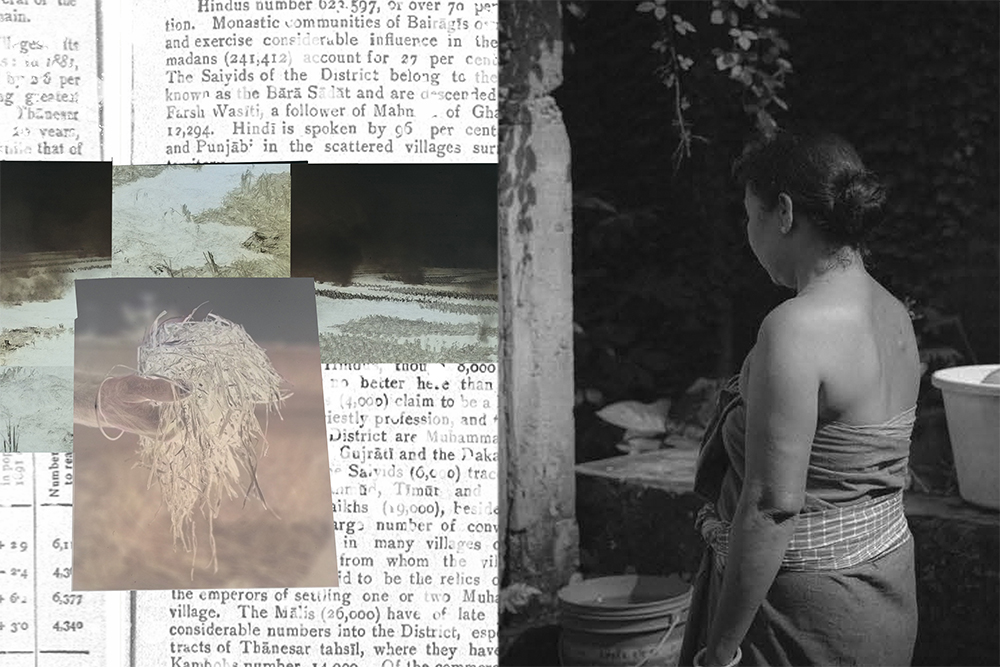
The Law of Small Distances
Artist statement
I am a Punjabi who lives in Gurgaon
I visit Punjab every year
On the Haryana–Punjab border I see lorries packed close together, forming blocks
the farmers’ protest stretches for half a kilometre.
I go back to my grandfather’s house,
built like a jenga tower, one story over another.
My uncle is a doctor in Sunam.
A woman visits, she wants medicine for her son
She asks my uncle to cut a few pills from a strip
She only has so much money.
Next door to his pharmacy, the wall still carries bullet holes from 1978
on the adjacent one, stenciled: Jai Shree Ram
He takes me to nearby farms
He says there is more poison here than on the tongue of politicians
I photograph the burning fields.
Sometimes the smoke turns the sky black
and confuses the birds.
I photograph the rough streets
men selling milk, school children releasing pigeons
some boys demand to be photographed
They want to be seen with their bike
I photograph the life around land, canals, and rivers
I visit a friend who’s a patwari.
He tells me canal water first went to large landlords, then to small farmers
We drink whiskey, he tells me his score is too low to go to Canada
He opens his steel almirah; among the files a book
Punjab Settlement Manual, 1931
We read from it:
“Lord Dalhousie laid down emphatically that by our occupation of the country, after the whole Sikh nation had been in arms against us, we have acquired the absolute right of conquerors, and would be justified in declaring every acre of land liable to Government assessment.”
I go to brick kilns near the highway.
My cousin talks to the owner while I photograph bricks stacked up
A tree is being cut in the distance
I can’t see it but hear the axe
Back in Gurgaon, I return to the darkroom.
I develop the negatives, look at them on a light bed.
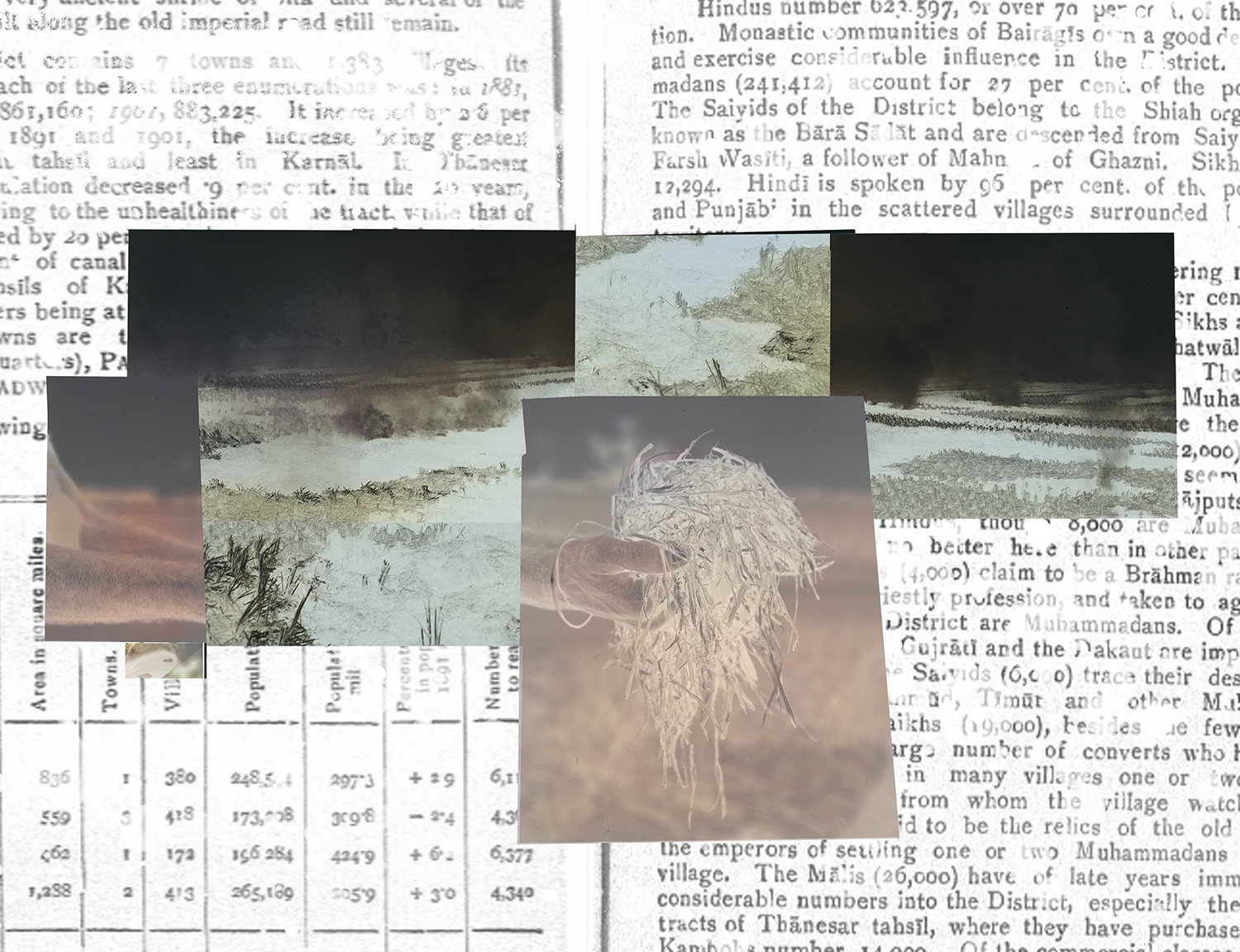
I cut them up, make smaller pieces,
and reorder them as a grid
At first I thought I was looking at division,
but it seems the real study is what refuses to remain divided.
Looking at the images, it felt like a bird’s-eye view of a field
and of the people who sing poems
at the time of struggle and resistance.
My project examines divisions and connections in Indian Punjab – long regarded as India’s breadbasket and testing ground for agricultural policy. Through photography and archival research, it investigates intertwined histories of farming, division, and ecological decline, and how colonial systems of ownership and measurement shape the present landscape. Using photography as mapping, it examines how lines drawn on paper; legal or agricultural, translate into lived divisions on the ground.
Returning to Patiala, Bathinda and Sangrur districts over recent years, I’ve photographed agricultural sites while researching their bureaucratic and historical logic. My reading includes A Tour in Punjab (1878–79), the Punjab Settlement Manual (1931), The Partition of Punjab by Kirpal Singh (1972), post-partition policy studies on land reform and the Green Revolution. Alongside I have been gathering oral histories, folk songs, and local poetry about land, displacement, and inheritance. These conversations include farmers, brick-kiln workers, and families living on divided ancestral land. Together, these materials form an evolving counter-archive that connects ecological degradation with longer cycles of policy, memory, and extraction.
This research comprises the project’s first stage. The next stage focuses on developing its visual and material form. I plan to visit remaining districts to document sites not yet photographed and to expand the archive of related colonial and governmental records. These will be re-layered as photographic collages that merge the languages of law, landscape, and collective memory. This approach draws from Édouard Glissant’s ‘Right to Opacity’—using the negative’s resistance to legibility and the fragmenting grid to create representations that refuse to be fully grasped.
The images currently exist as digital scans from negatives. With grant support, I will create layered transparency prints that connect photographic images with bureaucratic documents, to be hung in space or viewed through light boxes.
Writing remains integral to the process. Short prose texts developed during fieldwork accompany the images, reflecting on how histories of division and measurement continue to shape human and ecological relationships in Punjab. The grant will allow me to bring the work back to its sites of origin, organising small presentations in villages and towns for families and workers involved. Conceived as spaces for dialogue, they let local voices question how the land is seen and remembered.
Akshay Bhoan is a lens based artist. His practice explores the transitory nature of knowledge, memory, and perception – unfolding through photography, mixed media, and interactive installation. Bhoan constructs dialogues between past and present, tracing how historical residues shape identity and visibility in contemporary life.
Dhiraj Rabha
Dreams of a Mother
Artist statement
She dreams of rivers that once held her reflection,
of hills she could once climb without fear.
Between the smoke-stained walls of a detention camp and the vast silence of the forests, a mother
dreams, not of escape, but of return.
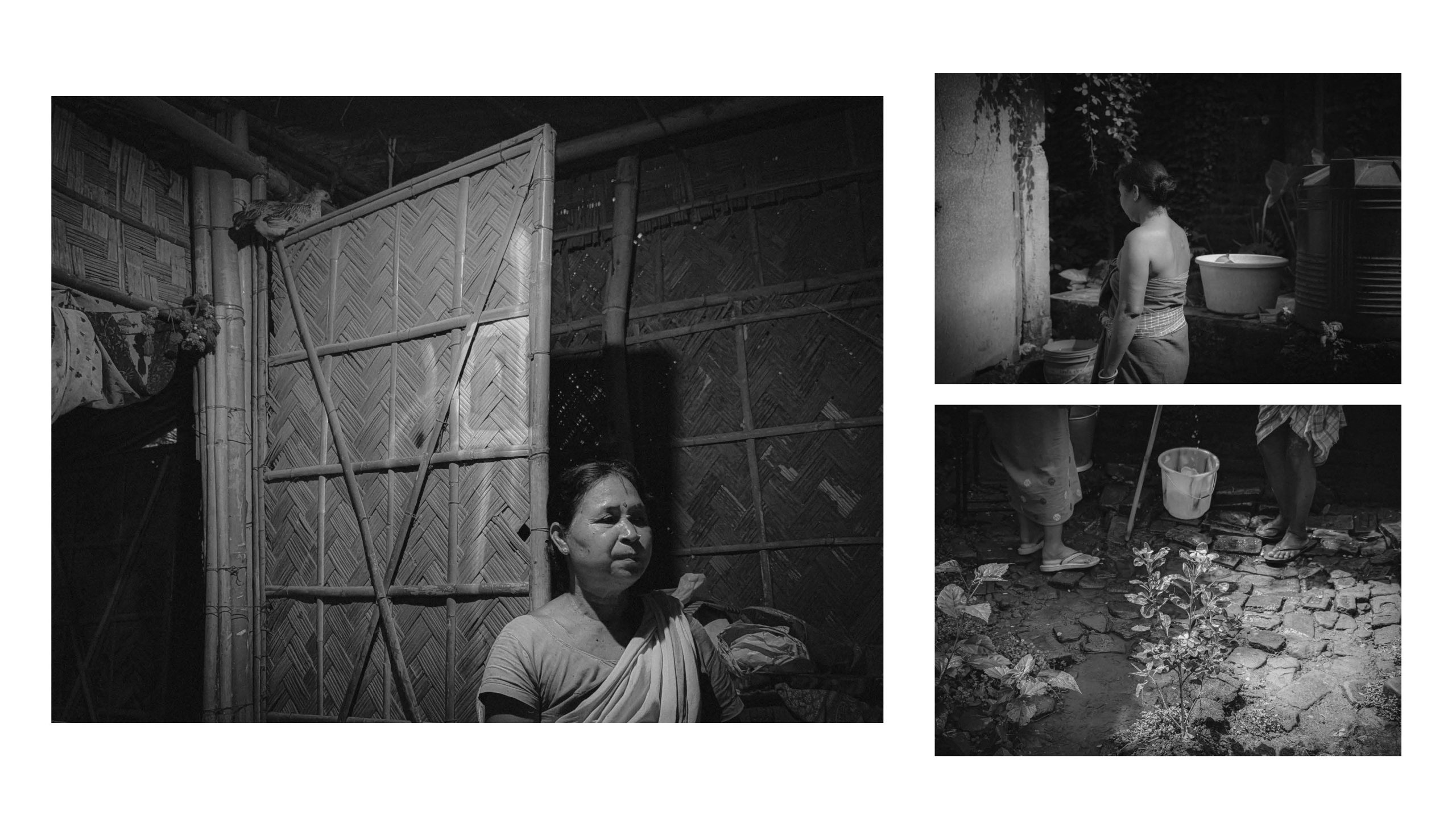
This project arises from those dreams, quiet, persistent, and deeply human. It continues my long-term exploration of memory, home, and the lingering shadows of insurgency in Assam. Rooted in my personal history, Dreams of a Mother focuses on my mother, who has lived for decades in an ex-ULFA detention camp following my father’s surrender in 1999. Because of her marriage to a man involved in the armed rebellion, she too was forced into a life of fear, displacement, and endurance, hiding from the Army, raising two children, and carrying the silent burden of survival. Now, after years of living within the camp, her desires are tender and grounded: to build her own home, to return to her ancestral village, to fish again, to climb the hills, to bathe in waterfalls. This project becomes an artistic dialogue with those unspoken wishes, a poetic and visual reconstruction of the life she imagined but never lived.
The photographs will unfold across three interconnected spaces: the detention camp, my ancestral village, and the adjoining forests, tracing a journey through the physical and emotional geographies that have shaped my mother’s existence. The images will reveal how conflict redefines women’s lives, compelling them to hold families together, to dream silently, and to endure with quiet strength. It will question how women carry the memory of violence, how they rebuild and reimagine their identities within and beyond the ruins of history. Ultimately, Dreams of a Mother stands as a reflection on resilience and the desire for freedom, not through political narratives, but through intimate dreams that seek to reclaim the right to live, to remember, and to imagine anew.
Beyond documentation, Dreams of a Mother seeks to become a living archive, a space where memory, longing, and resistance coexist. Building upon my earlier documentary series that traced the collective memory of communities shaped by insurgency, this new body of work shifts toward an introspective, dreamlike mode. It will extend my ongoing practice of transforming personal histories into shared reflections on loss, resilience, and the fragile hope of returning home. The visual language of Dreams of a Mother will unfold through a series of surreal and metaphorical tableaux that blend reality with imagination. Each frame will reimagine my mother’s life and inner world through dreamlike compositions that hover between memory, desire, and myth. The project will construct a poetic, multi-layered narrative that transforms my mother’s memories and unrealised dreams into a visual mythology of resilience and remembrance.
Dhiraj Rabha is a visual artist based in India. Raised in an ex-ULFA detention camp in Goalpara, he explores themes of displacement, identity, and resilience. His practice, primarily in painting, delves into the sociopolitical narratives of his surroundings, often reflecting his personal experiences and cultural heritage. Rabha’s notable projects include exhibitions at the Serendipity Arts Festival, curated by Vidya Sivadas, and the Next-Step Residency by the Sher-Gil Sundaram Arts Foundation. He has been recognized with the Generator Cooperative Production Fund by Experimenter (2023–24) and a production grant under the Art Practice Programme from India Foundation for the Arts (IFA) in 2022.
Jury
Ahlam Shibli is an artist, whose work has been presented in solo and group exhibitions internationally. Her work has been presented, among others, in Pompidou Metz, LUMA Westbau, LUMA Arles, Museo ICO, Seoul Museum of Art, Fotonoviembre, IVAM, Museum der Moderne Salzburg, MSU, UGM, Remai Modern, S.M.A.K., documenta 14, Cassa di Risparmio, Camera Austria, Carré d’Art, Zachęta, Qalandiya International, Henie Onstad Kunstsenter, Muzeum Sztuki, MACBA, Jeu de Paume, Museu Serralves, Museo Reina Sofía, Haus der Kunst, Galeria Kombëtare e Kosovës, Thessaloniki Biennale, Fondazione Sandretto Re Rebaudengo, Tate Modern, Muzeum Sztuki Nowoczesnej w Warszawie, Darat al Funun, Château de Sédières, CGAC, Pompidou Paris, Documenta 12, Bienal de São Paulo, Kunsthalle Basel, Busan Biennale, Seville Biennial, Istanbul Biennial, Torino Triennale, Yokohama Museum.
Gauri Gill is a Delhi based photographer. She has exhibited within India and internationally, including The V&A Museum, London; Louisiana Museum of Modern Art, Humlebæk; Schirn Kunsthalle, Frankfurt; 58th Venice Biennale; MoMA PS1, New York; Documenta 14, Athens and Kassel and the Kochi Biennale, Kerala. She has also consistently exhibited at locations outside of the art world, including public libraries, rural schools and non-profit institutions. She received the Prix Pictet award in 2023, and the Grange Prize in 2011, among other honours. She has recently published two books about her multi-year collaborations with Adivasi artists in Maharashtra, India, called Fields of Sight and Acts of Appearance, both published by Edition Patrick Frey, Zurich.

Sanjay Kak is an independent documentary filmmaker and writer whose work includes the films Red Ant Dream (2013), Jashn-e-Azadi (2007), and Words on Water (2002). He is the editor of the anthology Until My Freedom Has Come – The New Intifada in Kashmir and of the critically acclaimed photobook, Witness – Kashmir 1986-2016, 9 Photographers which he published independently under the imprint of Yaarbal Books. At Yaarbal he has also edited and published the recent Cups of nun chai by Alana Hunt. A self-taught filmmaker, he writes occasional political commentary, and reviews books that he is passionately engaged by. He has been active with the documentary cinema movement in India, and with the Cinema of Resistance project.
Announcement of Grantee: 23 November 2025
Jury Statement
Sanjay Kak: “First, thank you to the Umrao Singh Sher-Gil Grant for Photography for setting up what has turned out to be an energising encounter with a range of photography and lens-based art.
As a lapsed documentary film-maker and now an occasional publisher I remain an interloper to the world of photography as well as of the art gallery. But after two and a half days in that darkened room, looking at an impressive distillation of work that is brewing quietly around us, I come away in some wonder. We saw some great work there.
There was of course the strong imprint of the older, more familiar and in some ways more vital for me, practice of documentary photography. But there were also more intriguing, more transgressive practices. It was when we were going over these that I found myself watching my fellow jurors very carefully. For Ahlam Shibli and Gauri Gill are both not only acclaimed photographers, they are also well-versed in the shifting currents of contemporary photography. What I truly enjoyed was the way their opinions, often contrary to mine and even to each other, drew me away from my own familiar, solid ground. My warm thanks to them for that nudge.
And I do think our eventual decisions do a fair job of our negotiation with that swirling soup of ideas, politics, positions and ideologies.
If I have a quibble with the process that we went through—and here I speak only for myself—it is with the use of language in the proposals we read.
I have no doubt that the contemporary art world has been enriched by ideas that have arrived from the world of scholarship. My own work as a documentary film-maker has been immeasurably strengthened by the insights of academics. But does their frequently soul-deadening academic-speak have to be imported as part of the bundle? Can that space not be treated as the gym where we go to work out, tone our muscles, improve our flexibility. But then left there, and not mistaken for the practice?
A proposal for an artwork that comes peppered with the names of scholars and theoreticians, all great names no doubt, or comes laden with footnotes does not inspire confidence in me. It signals exactly the opposite. The barriers it sets up is not simply a matter of the wrapping in which it comes to us. Words are a window to our truest intentions, to our understanding of an idea, to our soul if you like. We need to stop using them as an opaque armour.”
Gauri Gill: “The process of jurying—or judging—is a difficult, if not impossible one. When I get letters from photographers who ask for advice on their work, I am put in a quandary for the very same reasons. Words have consequences, and are too often spoken in haste—carelessly, casually, and without the pertinent knowledge. The world itself can be a harsh one, especially for artists, but in fact, for all those attempting to swim upstream. It reduces our little attempts every day, it shows us our place, it wags its finger and seats us down. To be able to gather even a glimpse of someone’s deeper motivations, lived convictions and daily unseen circumstances is a vast exercise, and one involving much more time than a single personal encounter or simple reading of a portfolio will allow for.
However having been in the field for thirty odd years also means that one must bear some responsibility for this wonderful community of which we are all most privileged to be a part of, and that is held aloft by the generous dreaming and solid work put in by organisations such as the Sundaram Sher-Gil Arts Foundation. I grew up with Amrita Sher-Gil, my forever girlhood crush and inspiration. I was thrilled when my father told me that we were originally Sher-Gil, not Gill—however, we were certainly more common with two ls in the name, instead of only the stylish one! In any case, being Amrita is not as simple as a surname. My admiration for Umrao Singh came as I moved to photography from painting, but was equally affecting, not least for the profoundly moving and interdependent relationship he shared with Amrita. I began to sense then how much of what I thought I saw in and of her, was in fact the mythic image co-created by them both, and felt too his large and long influence on her in terms of stubborn self-belief. The individual keeps breaking down. In their own deeply sincere mutual endeavour, Geeta and Vivan have shown us what it means to be committed to the artistic enterprise, day and night, life long, in the bedroom and at the dinner table. So I thank SSAF for affording me this opportunity to serve. Finally, the whole experience was highly contingent upon my co-jurors, Ahlam and Sanjay, with whom I was locked in a room for two and half days without a break for even the smoggy sunlight, and with whom one shared most freely and discursively thoughts and ideas.
A few thoughts arising from what we found in these days. We were all struck by the number of proposals and the sheer effort put into them, which speaks to the lack of opportunity for independent and experimental artistic expression in our part of the world, and the utter absence of institutional and state support for photography in India. Applications came from as far afield as Goalpara, Assam; Bokara, Jharkand; Bandipora, Kashmir; Mhow, Madhya Pradesh; Amritsar, Punjab; Ziro, Arunachal Pradesh, and encompassed a range of identities across gender, community, caste and class. While recent developments in terms of zines, journals, workshops, conferences, festivals and so on, organised around ideas embedded in local practices are more hopeful, the long shadow of the globalising and flattening internet continues to cast its influence upon us, and I have been led to reflect once again upon borrowed thinking from what circulates online, rather than what may arise in person, inhabiting place. Rather than being imposed upon via adopted concepts, theory and jargon, the more interesting proposals involved specificity and granularity driven by what was found during the actual process of seeking and making; or what might arise from as well as be expressed holistically through the material itself.
Having suffered also from a lack of pedagogy in photography in our context, and subsequently being driven more by easily accessible technology, as well as the art market, rather than old school training and critical conversation with peers, there remains a gap in terms of photographic skills. Too much of what we see circulating today is basic digital photography, which, while democratising, can also have a boring sameness in its appearance. The interdisciplinarity across mediums which has arisen—with many of the proposals themselves incorporating elements of installation, sculpture, sound, painting, poetry, film and other art forms—perhaps seeks to address this lacuna. The expansion of any medium can only be a good thing, while simultaneously continuing to hope for a deepening of photographic understanding in and of itself so that one can make voluntary rather than involuntary artistic choices.
As a practitioner, I would like to mention a few projects to ground my words in examples, and which, while far from being a complete representation of the richness of all we saw, might help suggest the range and scale of ambition.
Maksud Ali Mondal proposes to continue his research within a disused tannery that carries traces of a post partition riot from 1950 in West Bengal, using charcoal as ‘an image born from what is burned’, as well as lime and powdered brick as pigments, materials central to the architecture. Krithika Sharma is reflecting upon generational memory and Dalit identity as embodied by her own parents, especially her mother, via a seminal Tamil Dalit feminist text, family albums, Ambedkarite speeches, letters and drawings. Akshay Bhoan uses photography to study legal and agricultural lines on the ground as embodied by those who experience them, creating a counter archive of micro histories in rural Punjab. Coming from studies in Painting and Political Science, Dhiraj Rabha begins his process with drawing, turning to photography to stage surreal moments evoking his familial experience of insurgency in Assam. Ishan Tankha has been making easy to travel zines to create a important documents of an ‘accumulation of exclusions’ across the country, thereby also circumventing mainstream modes of dominant narratives and dissemination. Mir Ijal Shaani would like to activate a fictional hotel room in a budget hotel called Hotel Kismat with queer lovers, strangers, migrants and performers, to evoke a sensory atmosphere—in his words, ‘these hotels smelled faintly of detergent, the air conditioners coughed like tired lungs. They weren’t destinations; they were escape routes, tiny emergency exits in a country that doesn’t want to see people like us.’ Kush Kukreja and Malavika Byju wish to upturn the ethnographic associations related to tapioca via remaking the crop into bioplastic film and paper surfaces to engage in collaborative image making with farming communities across Kerala, co-relating the material with its complex histories. Vani Bhushan is using a slow and unwieldy 4 x 5 analogue film camera to examine the new ‘renewable energy regime’ in the desert, with the sun as pivotal to her enquiry. Svabhu Kohli works with local activists to understand the reshaping of the ethics of elephant care, and the evolving discourse on animal welfare and human labour via oral histories, personal maps and annotated fields notes developed collaboratively with mahouts themselves to extend his accomplished drawing practice into the domain of documentary ethics via field immersion.
As opposed to the dull sensationalism and structural violence embedded in historic, colonial, outsider and top-down image making, many of the proposals have centred upon community, care, collaboration, conversation, mothers, illness and personal experiences of marginalised identities as integral to image formation. There was thankfully no proposal involving AI; but there was one using palash flowers. The medium and all that it allows for continues to shapeshift and enthrall.”
Ahlam Shibli: “During the last week, we looked at the works and read the proposals of a shortlist of sixty applicants whose proposals were accepted from nearly hundred applications from all over India and its vastly different communities. This large number indicates the value and importance of the Umrao Singh Sher-Gil Grant for Photography.
We deliberated at length with a further shortlist of 21 photographers and artists proposals. The interesting thing is no matter what the age of the artist is, their proposal provided the courage, perseverance and interest sometimes in the personal and often in the collective environment that affects the artist as an individual in a society. We arrived at seven pre-finalists. What caught our attention was the range of ambition between these seven candidates. The passionate photographer-artist who aspires to make their way in this profession of creativity and the photographer-artist who aims to develop their path and contribute to this world with their vision and artistic practices. The final shortlist of four was tough to arrive at. We circled over their previous works and their applications for the grant, between their proposed texts and their biographies, asking questions, giving answers—which mostly my co-jurors gave! I, ignorant of the history of India, needed the support of my colleague-friends. By a careful looking at and reading of each proposal, we arrived at the two grantees. That was even harder, not least because each of the photographer-artist had their own personal language to explore their truth in this most interesting, creative way. With this statement, we invite the grantees in alphabetic order: Akshay Bhoan and Dhiraj Rabha.”