

Conceptualised and facilitated by Anuradha Kapur, Neelam Man Singh Chowdhry, Gargi Bharadwaj, Amrithasruthi Radhakrishnan and Purav Goswami
28 September–4 October 2025
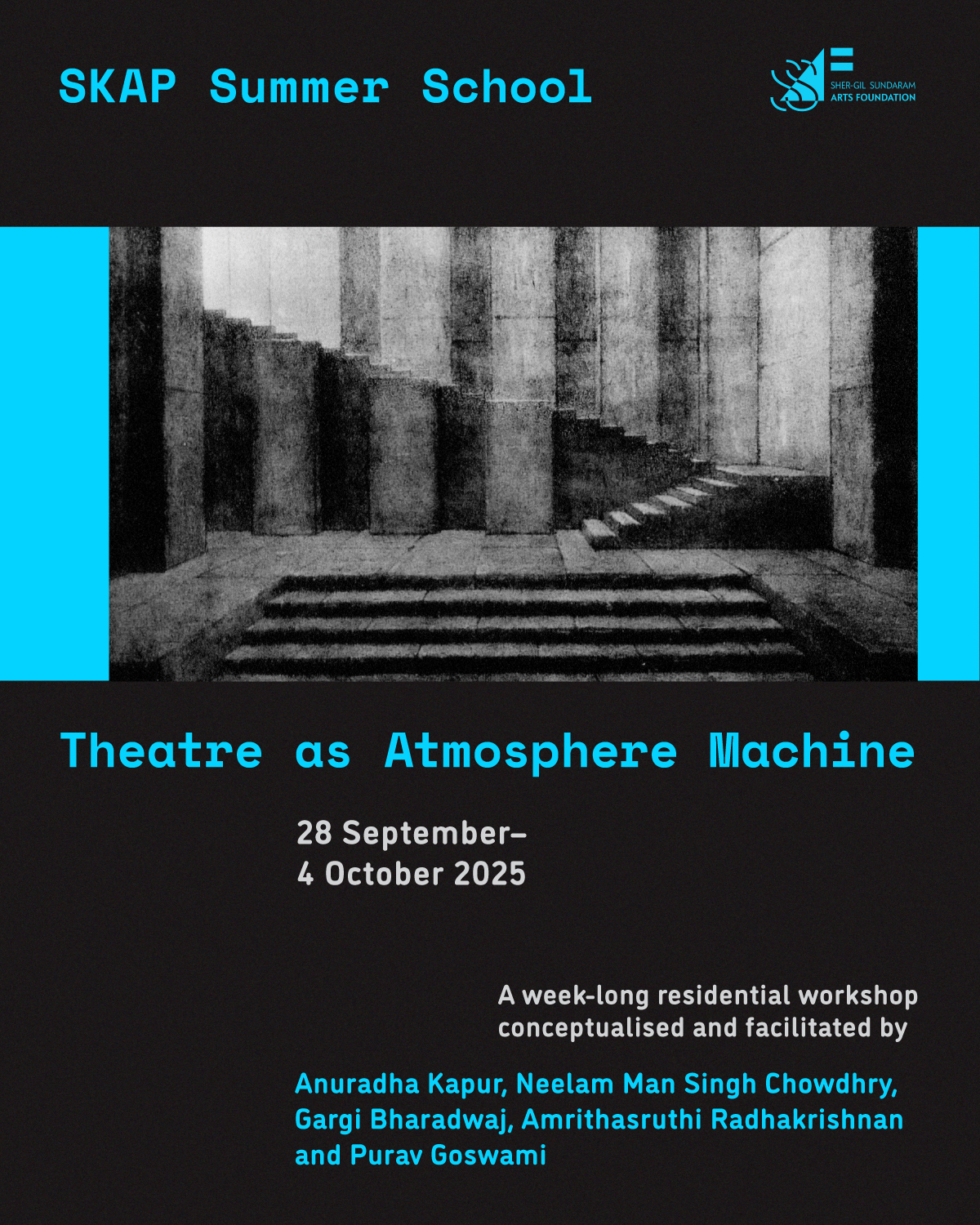
This weeklong workshop is about recognizing and rethinking the place of the senses in performance-making. Situated in the distinct environment of Kasauli, this thinking–doing workshop will attend to the tangible and intangible materials that shape our work in the theatre.
What is the weight of a mood? Does melancholy weigh the same as joy?
The largest frame within which we hope to make and see work is that of atmosphere, which in theatre is an experienced category but one that often remains unnoticed, even disregarded. The proscenium arch frames the visual while an open-air performance is unframed, affected by the elements. From the weight of a prop to the smell of wood or dust, and the intensities of sound, atmosphere is a pervasive and powerful presence in the way performance is constructed, encountered and remembered.
We ask:
- What shifts within performance when we centre the senses in its making and its viewing? How do space, light, sound, object, climate, text, thought and body shape meaning?
- What if the primary object of performance is not the unfolding of an exclusively human story, but recognizing both the small and large phenomena that shape it?
One cannot handle glass the same way one handles soil.
Materials and objects have both form and force. They have social histories – the history of glass is the history of manufacture, the history of soil is that of agriculture, and so on. To work with material, then, is to orient ourselves to what it brings forth – texture, location, scale – and the actions it demands. The reciprocity of human and non-human exchange is the basic condition of an aesthetics of atmosphere.
The workshop seeks to extend the ethos of the SKAP Summer School’s vision that centres embodied thinking, slow attention and processes of unlearning. It will be practice-oriented, and will aim to displace settled habits of conceptualizing, making and viewing.
The practice will involve:
- Building unlikely habitats: imagining homes for insects, birds, fish, humans
- Working with found objects and text: to compose scores, actions and narratives, both individual and collective
- Staging photographs: using images as points of departure for storytelling
- Shared reading, viewing and listening
The workshop hopes to open a space of playfulness, reflection and dialogue in theatre practice. By bringing atmosphere back into focus, it aims to re-energize the relation between theatre and the worlds outside it.
Facilitators
Anuradha Kapur is a theatre maker and teacher. She completed her term as Director National School of Drama, New Delhi in 2013. She has held Visiting Professorships at Ambedkar University, Delhi, the University of Warwick and at the University of Cape Town. For her work in the theatre, Anuradha Kapur was awarded the Sangeet Natak Akademi award for Direction in 2004.
Neelam Man Singh Chowdhry is a theatre maker. She is an alumni of National School of Drama and studied History of Arts for her master’s. She has been attached to The Rang Mandal, a theatre repertory in Bhopal, and later became a faculty member at The Department of Indian Theatre, Panjab University. She is the recipient the Sangeet Natak Akademi Award in 2003, and the Padma Shri in 2011. She is presently Professor Emeritus at the Panjab University.
Gargi Bharadwaj is a theatre and performance studies scholar. She is an alumni of National School of Drama with dual MA degrees from University of Amsterdam and University of Warwick and a PhD from the University of Hyderabad. She has published articles and essays on cultural policy and infrastructure, contemporary performance practice, gender and proto-feminist themes in cultural work and, dramaturgies of urban space among others. She is currently associate professor of practice, O.P. Jindal Global University, Sonipat.
Amrithasruthi Radhakrishnan is an Assistant Professor at Shiv Nadar Institution of Eminence, with a Ph.D. in Theatre and Performance Studies from the School of Arts and Aesthetics, Jawaharlal Nehru University. She is a trained dancer for over two decades with the Natya Vriksha Dance Collective. Her research attempts to bridge theory and practice in both academic and artistic domains. Her research focuses on performance, festival events, curatorial practice and cultural consumption, exploring alternate histories of performance reception.
Purav Goswami is a dramaturg and theatre maker and researcher from Assam, India. He is pursuing a PhD in Theatre from University of Cape Town, South Africa, as part of the Reimagining Tragedy from Africa and Global South project (ReTAGS) funded by the Andrew W. Mellon foundation (2019-2024). Currently, he resides and works from Delhi, India.
Participants
Akanksha Kumari is currently completing a Post Graduate Diploma in Teaching & Learning Dance for IB Curriculum, and has a Masters in Performance Practice (Dance) from Ambedkar University, Delhi.
Ankit Ravani completed an MFA from the School of Humanities and Social Sciences, Shiv Nadar University in 2018 and works as a researcher, writer and artist.
Bhumisuta Das completed a BA (Hons.) in Journalism & Mass Communication from the Seth Anandmohan Jaypuria College, Kolkata and a 3 year Diploma in Dramatics from the National School of Drama in 2019.
Devadeep Gupta completed a Masters of Fine Arts from Bauhaus University, Weimar, Germany in 2019 and a Bachelor of Architecture from the School of Architecture and Landscape Design, J&K, India.
Gandharv Dewan has a PG Diploma in Acting from the National School of Drama (2015) and is visiting faculty for Modern Indian Literature and Modern European Drama at the Whistling Woods International, Mumbai.
Mansi Thapliyal completed a PG Diploma in Photography & Visual Communication, MCRC, Jamia Millia Islamia in 2010 and an MA in Performance Studies from Ambedkar University, Delhi in 2018. She works as a Waldorf Educator and Photographer.
Rishika Kaushik is a theatre maker, writer and teacher based in Delhi. She completed a PG Certificate Course in Acting and Theatre Making from the Drama School, Mumbai in 2023.
Ruhani Singh is a theatre and film artist who has trained at the Muhlenberg College, Pennsylvania and the Creative Arts Academy, Kolkata.
Ruthi Lalrinawmi completed a Masters in Performance Arts (Theatre Arts) from the University of Hyderabad. She currently teaches theatre at the Aga Khan Academy, Hyderabad.
Twaha Abdul Majeed completed an MFA in Technical Design & Production from the David Geffen School of Drama, Yale University in 2025. He works as a production manager and theatre artist.
Uma Katju completed an MPhil in Political Science from JNU in 2010 and has a professional diploma in Intercultural Theatre (Acting) from the Intercultural Theatre Institute, Singapore. She works as an actor and theatre maker.
Vijaya Singh completed a Certificate course in TV Direction, Film and Television Institute of India, Pune, 2015, and has a PhD (2004) from Department of English, University of Rajasthan, Jaipur.
A note from the facilitators—
“The call for participation in the upcoming SKAP Summer School workshop, Theatre as Atmosphere Machine, was met with an overwhelming response. We received a total of 213 applications from diverse backgrounds, including performance makers, actors, writers and scholars, from across the country. We are able, however, to include only 12 participants in this year’s edition.
The process of selection involved thorough deliberations on the artistic concerns of each applicant. In line with the vision of the SKAP Summer School, we have attempted to create a cohort of participants across disciplinary boundaries. The final selection is based not on individual applications alone but on how the workshop might influence their work going forward, as well as practical considerations of the limited space on site. Consequently, we had to let go of many promising applicants. We hope to be able to connect with them in the future.”
You can view here the Call for Applications
Essential Information
We invite applications from performers, theatre-makers, dancers, scenographers, writers, designers, researchers, and others interested in the process of performance-making.
Eligibility
- The workshop is open to Indian nationals currently residing in India.
- Applicants must be at least 23 years of age at the time of application. There is no upper age limit.
Important Dates
- Deadline for submitting applications: 3 September 2025
- Workshop dates: 28 September–4 October 2025
- The selection process will include a brief online conversation in English/Hindi. Shortlisted candidates will be notified by the first week of September, and the conversations will be held on September 9, 10 and 11, 2025.
- Participants are expected to arrive a day prior on 27 September and depart on 5 October 2025.
Costs
- There are no participation fees.
- Accommodation (shared basis) and food for the duration of the workshop in Kasauli will be covered by SSAF.
- Participants will pay for the travel to and from Chandigarh/Kalka. In case you are unable to do so, please write to us at: kasauliartproject@gmail.com
SSAF will arrange transport from Chandigarh/Kalka to SKAP.
The closest train stations are in Chandigarh (1.5 hours by road from Kasauli) and Kalka (45 minutes by road from Kasauli). There are several trains daily to Chandigarh and Kalka from Delhi. The closest airports are in Delhi and Chandigarh.
Application
Please submit your application via the form HERE.
Responses to Section 3 of the form may be submitted in any Indian language. The medium of instruction in the workshop will be English and Hindi.
The application requires the following material:
- Your personal information including name, contact number, email, residing address and date of birth
- Educational and Professional Overview
- Resume/CV. Please upload a brief resume detailing your educational background, relevant work experience, and/or creative and research-based practices. Upload as a PDF document. [maximum 2 pages]
- Documentation of work. Please provide details of 3–5 works or projects that reflect your current practice and concerns. You may include images, links to audio/video files, writing on/for theatre (fiction or non-fiction). If you are providing external links, ensure they are accessible (include passwords if necessary). This material does not have to be limited to performance or theatre-based work, and can include writing, design and research. Upload as a PDF document.
- Reference. Name and contact information of one referee. We do not require a letter.
- Response statements
- Why are you interested in this workshop? How does the exploration of atmosphere in performance connect with your current practice, questions or curiosities? Upload your response as a PDF document. [maximum 300 words]
- How do you relate to the proposition of the SKAP Summer School in terms of what you are thinking, imagining, working on and/or struggling with at the moment? Upload your response as a PDF document. [maximum 300 words]
- Additional Information: Anything else you might like us to know about you or/and your practice. Upload as a PDF document.
For queries, please write to us at ssaf.kasauliartproject@gmail.com