

Conceptualised and facilitated by Anuradha Kapur, Neelam Man Singh Chowdhry, Gargi Bharadwaj, Amrithasruthi Radhakrishnan and Purav Goswami
5–12 June 2026
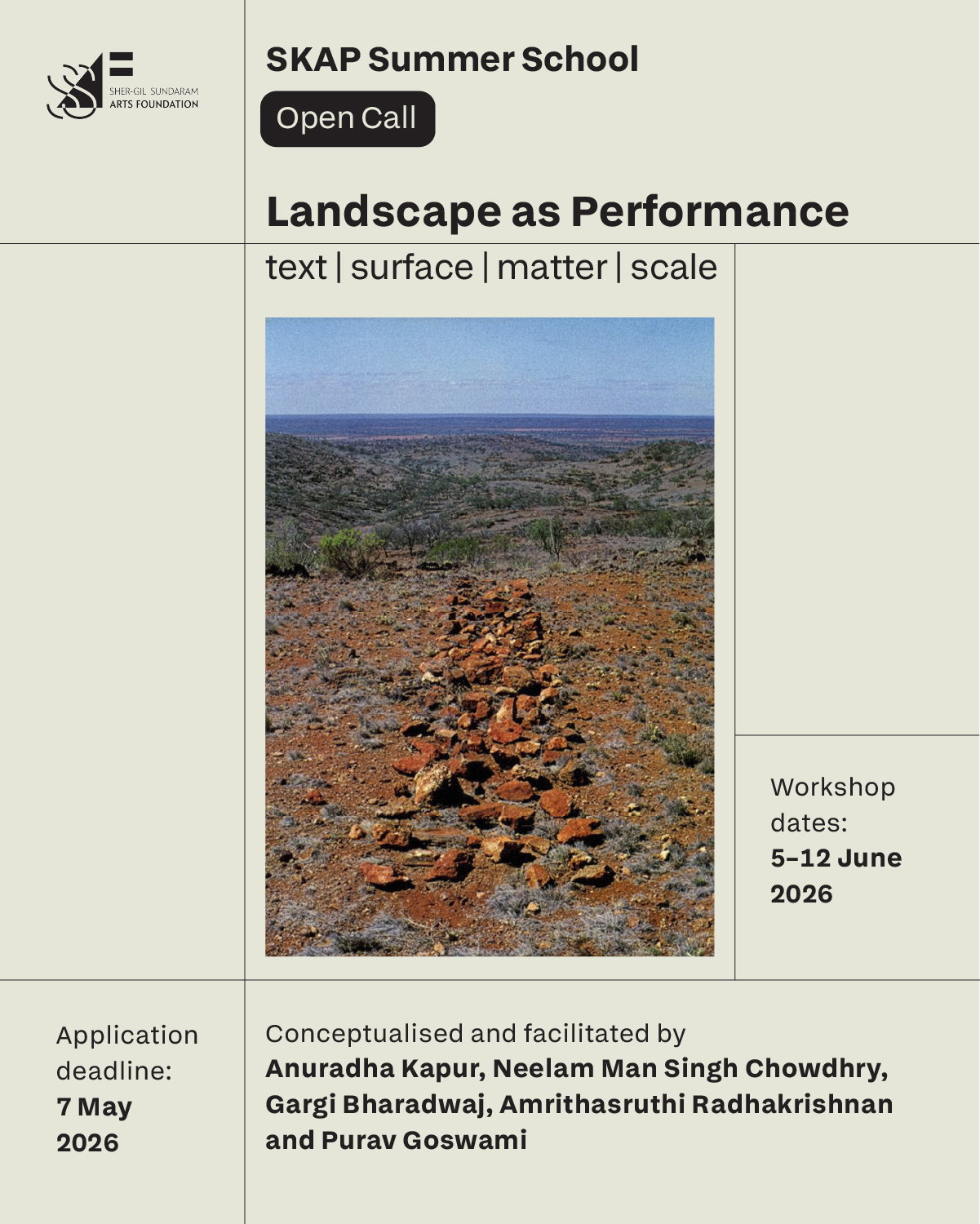
Image: Richard Long, A Line in Australia, created outside Broken Hill, 1977
This workshop focuses on landscape in and as performance. While the two terms — landscape and performance — may seem unconnected, it is useful to remember that Greek theatre did not have a built structure; it modified hillsides to create performance spaces. This workshop, then, reflects on the interplay between theatre/performance and the world outside.
We ask:
What is it that turns land into landscape? How do we create performance against, with or within a landscape? How do our actions affect or transform it? To put it the other way around, what does the landscape relay back to us?
Working with landscape is not the same as working with a specific site, where meaning depends on the site’s architecture and history. A landscape is neither merely natural nor merely historical. As a composition of sky, cloud, bird, river, rock, tree, plant, alongside built structures like path, wall or bridge, a landscape is constantly made and remade by environmental and human forces. These elements interact with and transform one another, and the landscape, over time.
We engage with landscape as an expanded field that ranges from a physical space to a metaphor, asking how it might reshape the processes of performance-making. Text, surface, matter and scale offer ways of tuning our awareness to how time, rhythm and atmosphere shift.
The SKAP Summer School and its location in Kasauli provide the context within which a set of activities drawn from performance and theatre practice will be attempted. The methodology of the workshop is a sequence of ‘scores, instructions, prompts and briefs’ (Wicked Arts Assignments, 2020) that takes the form of thinking-making exercises, alongside screenings, readings and discussions.
Facilitators
Anuradha Kapur is a theatre maker and teacher. She completed her term as Director National School of Drama, New Delhi in 2013. She has held Visiting Professorships at Ambedkar University, Delhi, the University of Warwick and at the University of Cape Town. For her work in the theatre, Anuradha Kapur was awarded the Sangeet Natak Akademi award for Direction in 2004.
Neelam Man Singh Chowdhry is a theatre maker. She is an alumni of National School of Drama and studied History of Arts for her master’s. She has been attached to The Rang Mandal, a theatre repertory in Bhopal, and later became a faculty member at The Department of Indian Theatre, Panjab University. She is the recipient of the Sangeet Natak Akademi Award in 2003, and the Padma Shri in 2011. She is presently Professor Emeritus at Panjab University.
Gargi Bharadwaj is a theatre and performance studies scholar. She is an alumni of National School of Drama with dual MA degrees from University of Amsterdam and University of Warwick and a PhD from the University of Hyderabad. She has published articles and essays on cultural policy and infrastructure, contemporary performance practice, gender and proto-feminist themes in cultural work and, dramaturgies of urban space among others. She is currently Associate Professor of Practice, O.P. Jindal Global University, Sonipat.
Amrithasruthi Radhakrishnan is an Assistant Professor at Shiv Nadar Institution of Eminence, with a Ph.D. in Theatre and Performance Studies from the School of Arts and Aesthetics, Jawaharlal Nehru University. She is a trained dancer for over two decades with the Natya Vriksha Dance Collective. Her research attempts to bridge theory and practice in both academic and artistic domains. Her research focuses on performance, festival events, curatorial practice and cultural consumption, exploring alternate histories of performance reception.
Purav Goswami is a dramaturg and theatre maker and researcher from Assam, India. He is pursuing a PhD in Theatre from University of Cape Town, South Africa, as part of the Reimagining Tragedy from Africa and Global South project (ReTAGS) funded by the Andrew W. Mellon foundation (2019-2024). Currently, he resides and works from Delhi, India.
Participants
Aditi Gautam has a Masters in Social Work from Tata Institute of Social Sciences, Mumbai (2016) and a PG Diploma in Theatre (Acting) from the National School of Drama (2023).
Dhwani Vij has an MA in Theatre (Physical Theatre and Performance) from Royal Holloway College, University of London (2012-13) and a BA in English from Kirori Mal College, Delhi University (2008-11). Currently, Dhwani works as a theatre-based facilitator in the Arts Department at Shiv Nadar School, Faridabad.
Kazi Sharowar Hussain completed an MA in Cultural Studies from Tezpur University (2018-21). He recently received an Arts Research Grant from the India Foundation for the Arts for visual ethnographic research on the boats and cultural life of Char-chapori region in Barpeta district, Assam.
Millo Ankha is an indigenous poet, artist and storyteller from Ziro, Arunachal Pradesh. In 2020, Ankha founded AAMA Collective – a collective of women visual artists to address the absence of women’s perspectives in North-East India.
Mridupankhi Rajkumari has a PhD in Theatre and Performance Studies from Jawaharlal Nehru University, New Delhi (2024) and an MA in Performance Studies from Ambedkar University, Delhi (2015). Mridupankhi is a practitioner of Sattriya dance.
Murari Jha is a Delhi-based artist and educator. He completed his BFA from Patna University (2010) and MFA from Dr. B. R. Ambedkar University, Agra (2012).
Nikhita Singh studied Media and Cultural Studies at Tata Institute of Social Sciences, Mumbai (2016-18). Nikhita is the founder and director of Parwana Theatre.
Pallav Singh pursued an MFA in Acting from National School of Drama, New Delhi (2016-19). Pallav is an engineer-turned-theatre actor currently based in Mumbai.
Pranjal Vaid studied Acting and Theatre Making in Drama School Mumbai (2022-23). Currently, he is studying at the Riyaaz Academy for Children’s Literature run by the Ektara Trust.
Shubham Ahirwar completed his Bachelors (2022) and Masters degrees (2024) in Painting from the Government College of Fine Arts, Jabalpur.
Shubhra Dixit studied Media and Cultural Studies at Tata Institute of Social Sciences, Mumbai (2013-15). Her research-based documentary films have been shown in many film festivals in the country and abroad.
Yogendra Singh completed a 3-year Acting Diploma from the National School of Drama, New Delhi (2011-14) and an NSD Fellowship in Clowning with Abhilash Pillai in 2014-15.
You can view here the Call for Applications
Essential Information
We invite applications from performers, theatre-makers, dancers, scenographers, writers, designers, researchers, and others interested in the process of performance-making.
Eligibility
- The workshop is open to Indian nationals currently residing in India.
- Applicants must be at least 23 years of age at the time of application. There is no upper age limit.
Important Dates
- Deadline for submitting applications: 7 May 2026, 11.59 pm [Please note that the deadline will not be extended]
- Workshop dates: 5–12 June 2026
- Participants are expected to arrive a day prior on 4 June and depart on 13 June 2026.
- Shortlisted applicants may be invited for a brief conversation with the facilitators between 10–14 May 2026.
Costs
- There are no participation fees.
- Accommodation (shared basis) and food for the duration of the workshop in Kasauli will be covered by SSAF.
- Participants will pay for the travel to and from Chandigarh/Kalka. In case you are unable to do so, please write to us at: ssaf.kasauliartproject@gmail.com
SSAF will arrange transport from Chandigarh/Kalka to SKAP.
The closest train stations are in Chandigarh (1.5 hours by road from Kasauli) and Kalka (45 minutes by road from Kasauli). There are several trains daily to Chandigarh and Kalka from Delhi. The closest airports are in Delhi and Chandigarh.
Application material
Please submit your application via the form HERE.
Responses to Section 3 in the form may be submitted in any Indian language. The medium of instruction in the workshop will be English and Hindi.
The application requires the following material:
- Your personal information including name, contact number, email, residing address and date of birth
- Educational and Professional Overview
- Resume/CV. Please upload a brief resume detailing your educational background, relevant work experience, and/or creative and research-based practices. Upload as a PDF document. [maximum 2 pages]
- Documentation of work. Please provide details of 3–5 works or projects that reflect your current practice and concerns. You may include images, links to audio/video files, writing on/for theatre (fiction or non-fiction). If you are providing external links, ensure they are accessible (include passwords if necessary). This material does not have to be limited to performance or theatre-based work, and can include writing, design and research. Upload as a PDF document.
- Reference. Name and contact information of one referee. We do not require a letter.
- Response statement: How do you relate to the proposition of the SKAP Summer School? How will participating in the workshop Landscape as Performance help you in your current work? [maximum 500 words. Upload your response as a PDF document.]
- Additional Information: Anything else you might like us to know about you or/and your practice. Upload as a PDF document.
For queries, please write to us at ssaf.kasauliartproject@gmail.com
Frequently asked questions
- I was a participant in a previous SKAP Summer School, may I apply again?
Unfortunately, you may not apply again this year as we would like to extend the opportunity to participate in the SKAP Summer School workshops to more people.
- I applied for a previous SKAP Summer School but did not participate, may I apply again?
Yes, we encourage you to apply again, even if you have applied for any of the SKAP Summer School workshops previously.
- Is this an actor training workshop?
No, this is not an actor training workshop.
- Will the SKAP Summer School result in a theatre/performance production?
No, the SKAP Summer School workshop will not lead to a theatre production.
- If I am not selected as a participant, may I attend as an observer, if I make my own stay arrangements?
The SKAP Summer School workshops may be attended only by selected participants.