

Disruptive Photography:
Conceptualised and facilitated by Madhuban Mitra & Manas Bhattacharya
3–9 August 2026
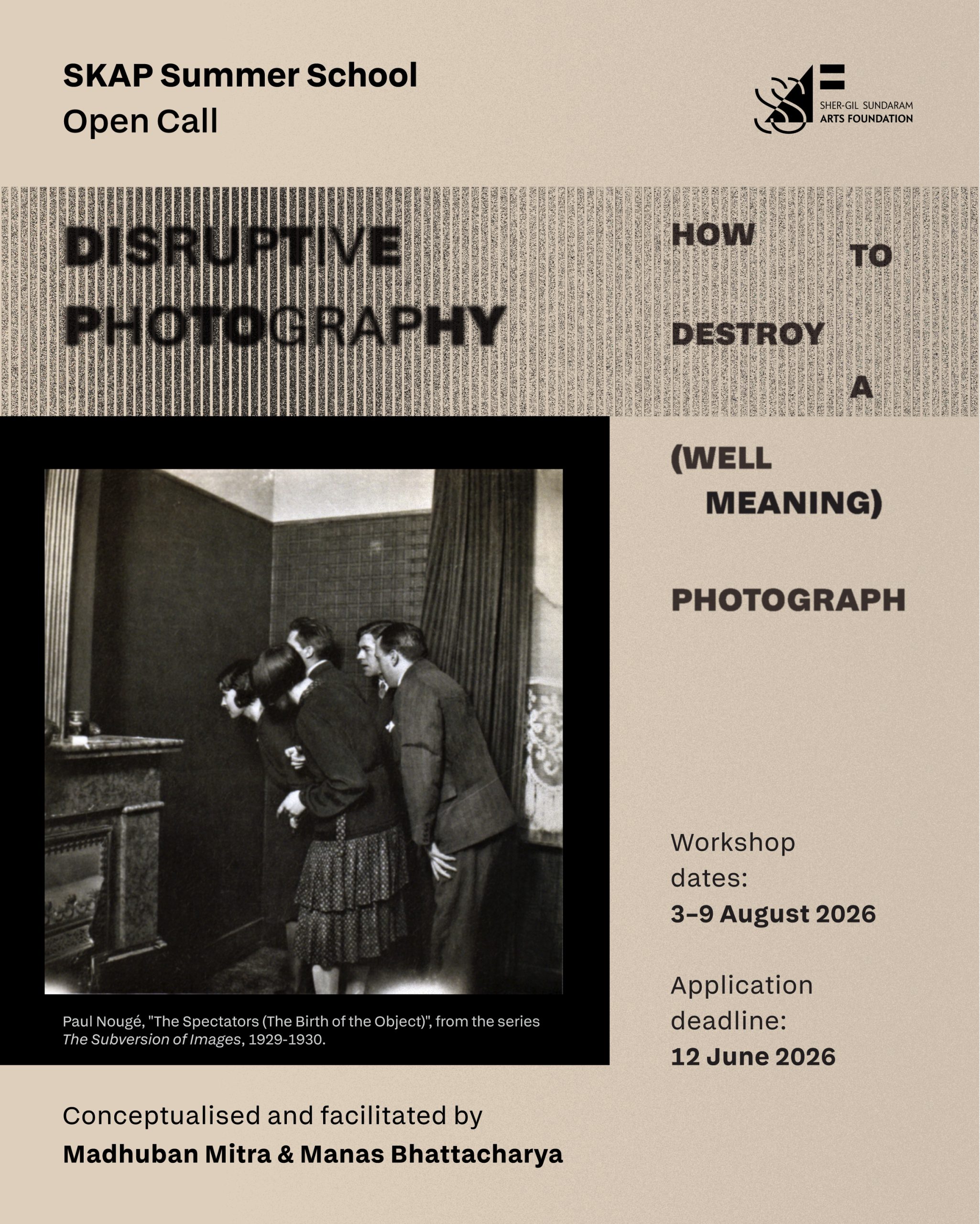
For nearly two centuries, photography has been predominantly perceived as a reliable chronicler — a straightforward, stable medium faithfully recording the visible world with an almost “scientific” precision. ‘The camera never lies’ is a widespread adage, informed by the belief that lenses objectively mirror reality. Yet even a basic scrutiny of the medium and its mechanics reveals the opposite. Photographs are highly subjective representations; their resemblance to the visible world contingent not only on human intervention, but technical choices and conditions of production. So, how did photography become the ultimate truth machine? Consider the vast applications photography has had since its inception, in news, legal evidence, scientific documents, diagnostics, military and police records, propaganda, advertising, family souvenirs, documentation of art works and so on, with a small fraction existing as art per se. A profound misunderstanding stems from this entrenched trust in indexicality and objectivity and endures across domains, art and otherwise. Ironically, photography’s integration in the art world owes much to it.
This intensive Summer School workshop interrogates photography’s pious facade, its claim to unmediated reality, social good and emotional authenticity. We will explore a range of artistic practices, historical and contemporary, that question the camera’s relation to the visible, undermine claims of empirical reproduction and unsettle our attempts to tame images to mean in certain ways rather than others. To scrutinize the concepts, strategies, methods and processes deployed in these disruptive practices is to undermine photography’s conventional assurances and certitudes. Drawing attention instead to the material, social, and cultural conditions that inform images as communicative objects, we look at how they congeal into form, manipulate meaning and affect, and empower a nimble and potent politics of the image. The workshop focuses on those practices that propose a politics of representation rather than a representation of politics. At its core, the aim is to understand how to make photographs shed their descriptive, informational baggage and make them speak in other ways. Prepare to torch the good intentions.
Our enquiry will follow several art-historical strands, hopping across eras and geographies, to study a diverse range of experiments and approaches that opened up formal possiblities within this medium, ranging from 19th century Ghost/ Spirit photography to the Conceptual Art of 1960s-70s. How does the curious genre of Victorian post-mortem/Memento Mori photographs disrupt notions of presence and identity in portraiture? How did Dada, Futurist and Surrealist photography interrupt conventional optics and and propose a new visual language that recast photographs as poetic and enigmatic image-objects? How could the photographic experiments of Indian Modernist Artists like Jyoti Bhatt, Krishen Khanna, Nasreen Mohamedi et al have led us to a very different poetics of photography, but was largely ignored and misunderstood in its time and is often elided from the history of photography in the subcontinent? The work of 1960s-70s Conceptual photographer-artists like John Hilliard, Franco Vaccari, Robert Heinecken, Giulio Paolini, Kenneth Josephson, Jan Dibbets, Jiro Takamatsu, Dora Maurer, Barbara Kruger, Victor Burgin among others, complicated the ways in which images were made and viewed, frequently using language or textual elements, borrowing and adapting concepts and methods from Feminism to Post-Structuralism. We take a deep dive into contemporary practices as well, particularly artists like Thomas Demand, Adam Broomberg & Oliver Chanarin, Hans Eijkelboom, Joanna Hadjithomas & Khalil Joreige, Joachim Schmid, Yao Lu, Oscar Muñoz, Boris Mikhailov, John Stezaker, Rosangela Renno and Thomas Ruff among others, to understand how their work investigates the nature of images and their relationship to the visible world.
As we step into the era of generative Artificial Intelligence, it might be prudent to remember that the invention of photography disrupted the relationship between the human eye and the visible world, particularly the representational arts, and inaugurated a novel but fraught bond between world and image, a tension we still navigate. Contrary to the widely held belief here, that photography can and does describe the world we live in, and what is photographed must have existed and is therefore true, we would like to propose that photography is inherently transformative, anarchic and defies description. The workshop maps a counterintuitive trajectory, illuminating marginal and edgy practices beyond the canonical signposts, bringing to the spotlight the often overlooked but radical possibilities of photography.
Facilitators
Manas Bhattacharya and Madhuban Mitra have been working together as an artist duo for the last decade and half, primarily with photography, film and video and more recently, Artificial Intelligence. Madhuban studied English Literature and holds a Ph.D in Cultural Studies. Manas studied Cinematography after completing a Masters in Comparative Literature. Their practice probes the nature of images and their relationship to society, politics and technology, with a particular interest in how history and memory both shape, and in turn are shaped by images. Often driven by extensive research, their work oscillates between and often combines documentary and fiction, analogue and digital, images made and found, still and moving, abstraction and figuration. Their work resides in the permanent collections of the Kiran Nadar Museum of Art (KNMA), Museum of Contemporary Photography (MoCP) Chicago, Fondazione MAST, Bologna, and private collections around the world. They conceived and developed the curriculum for courses they taught as visiting faculty in the Masters programme in Photography at the National Institute of Design (NID), Gandhinagar, between 2017-2022.
Participants
Aditi Aggarwal is a visual artist who lives and works in her studio in Kala Dham Greater Noida. Aditi obtained an MFA in Painting from College of Art, New Delhi. She also completed her PhD in Fine Arts from University of Delhi in 2023.
Agraj Nagarkoti is a visual artist based in Dehradun. She completed her Bachelors in Fashion Communication from National Institute of Fashion Technology, Gandhinagar and is currently pursuing a Masters in Photography Design from the National Institute of Design, Gandhinagar.
Anurag Paul completed a BFA from Sister Nivedita University, Kolkata and an MFA from Shiv Nadar Institute of Eminence, Greater Noida, in 2025. He lives and works in Kolkata.
Aparna Chivukula is a poet, writer and researcher who currently teaches English literature at Paradise School in Goa. She has a BA in Communication Studies from Mount Carmel College, and an MA in Literary Arts and Creative Writing from Ambedkar University Delhi.
Bhruvi Bhatia is a writer-critic based in Panipat. She has a BA in English from Delhi University and an MA in English and Cultural Studies from Christ University, Bangalore.
Brishbhanu Baruah is a filmmaker, photographer and writer based in Guwahati. He completed a BA in History from Hindu College, New Delhi in 2013 and has a PG Diploma in Film Direction from Film & Television Institute of India, Pune.
Divya Cowasji is a photographer currently based in Mhow, Madhya Pradesh. She completed her MA in Media & Cultural Studies from Tata Institute of Social Sciences, Mumbai in 2010 studied at the Photography and Alternative Photographic Practices programme at the International Centre of Photography, New York in 2015.
Jashandeep Kaur completed an MFA in painting from the Government College of Art, Punjab University, Chandigarh in 2022. She lives and works in Chandigarh.
Lalita Khurana is a researcher and writer based in New Delhi. She has a BSc in Sociology and an MA in Arts and Culture (2023-25) from the University of Amsterdam.
Mishika Goel is an artist, writer and researcher who completed her MA in French Literature from the Centre of French & Francophone Studies, JNU, New Delhi in 2024.
Parth Itwala completed an MFA from the Faculty of Fine Arts, The Maharaja Sayajirao University, Baroda in 2025. He lives and works in Baroda.
Raju Biswas is a cinematographer and director based in Delhi. He completed his MA in Mass Communication and Research from Mass Communication Research Centre, Jamia Milia Islamia, New Delhi in 2010 and a PG Diploma in Cinematography from Film and Television Institute of India, Pune in 2017.
Sneha Biswas is an artist, writer and researcher based in Kolkata. She graduated with an MFA in Art History from Kala Bhavan, Visva Bharati University, Shantiniketan and an MA in English Literature from Jadavpur University, Kolkata (2023-25).
Suman Karmakar is an artist based in Shantiniketan, West Bengal. He is completing his MFA in Painting from Kala Bhavan, Visva Bharati University.
Shubham Lodha is a self-taught photographer from Rajasthan. His work has been published and exhibited in India and abroad.
Yashna Kaul is a photographer and designer. Her work has been exhibited and published extensively in India and internationally. She obtained her BFA in Photography & Imaging from Tisch School of the Arts, New York University in 2018.
You can view here the Call for Applications
Essential Information
Eligibility
- The workshop is open to Indian nationals currently residing in India.
- Applicants must be at least 21 years of age at the time of application. There is no upper age limit
- There is no requirement of strict disciplinary affiliation. In fact, those working between and beyond disciplines will find themselves most at home. For this particular workshop, the only requirement is a history of engagement with or interest in working with images.
Important Dates
- Deadline for submitting applications: 17 June 2026, 11.59 pm
- Workshop dates: 3–9 August 2026
- Participants are expected to arrive a day prior on 2 August and depart on 10 August.
- Shortlisted applicants may be invited for a brief conversation with the facilitators.
Costs
- There are no participation fees.
- Accommodation (shared basis) and food for the duration of the workshop in Kasauli will be covered by SSAF.
- Participants will make arrangements and pay for their travel to and from Chandigarh/Kalka. In case you are unable to do so, please write to us at: ssaf.kasauliartproject@gmail.com
SSAF will arrange transport from Chandigarh/Kalka to SKAP.
The closest train stations are in Chandigarh (1.5 hours by road from Kasauli) and Kalka (45 minutes by road from Kasauli). There are several trains daily to Chandigarh and Kalka from Delhi. The closest airports are in Delhi and Chandigarh.
Application material
Please submit your application via the form HERE. The medium of instruction in the workshop will be English.
The application requires the following material:
- A resume detailing your educational and professional background/experiences, and the history of your work/practice. [maximum 2 pages]
- A portfolio of your selected work/projects, that provides an overview of your current practice, and helps us understand the core interests, concerns, processes that inform it and/or the locus of inquiries, experiments, explorations or research undergirding it. The portfolio does not need to follow any particular format. You may structure it in the way you think it best provides a window to your work. The portfolio need not necessarily be restricted to or include only photographic/photo-based work. For example, if you are a writer/critic, it could include a selection or excerpts from texts you have written. If you are a filmmaker or sculptor or painter, it could include links to your work in those media. Please include short contextual notes or synopses where appropriate. You may include open links to your artworks in any medium and/or writing (in case they are password-protected, please mention the passwords alongside) or any other material you think is pertinent.
- A statement of interest about the topic of this workshop — Disruptive Photography: How to Destroy a (Well Meaning) Photograph. What specifically motivates you to participate in this particular workshop? How does the trajectory of your work or inquiries intersect, align, overlap or connect with the workshop’s premise? What are the questions, doubts or convictions that bring you here? What do you expect or hope to discover or explore in this workshop? [maximum 500 words]
-
A note with your response to the TWO images below. Tell us your thoughts about both the images. How do you see them or what do they communicate to you? How do they excite, puzzle, disturb or inspire you and why? Do they confirm or challenge, unsettle and test your ideas and assumptions about photography? What kind of questions, doubts or convictions do they engender? Do they make you think differently about photography, and if so, how?
We do not expect a well-crafted essay. Please feel free to express your thoughts in whatever way you are comfortable with, but in your own words. Please do not just describe the image, rather put down what you think of them.
Please talk about both images. Do not omit either of them. Focus on the specific images, rather than just the series they are part of.Please do not reproduce what you can find online about these works. We are only interested in how YOU respond to them.
Please do not use ChatGPT or similar AI tools to write this note. We are interested in what you think. [maximum 750 words in total]
Image 1: Click here to view an enlarged image
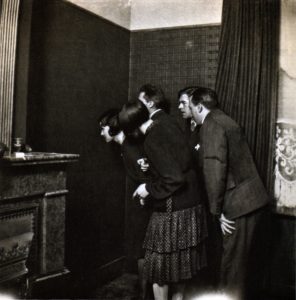
Paul Nougé, “The Spectators (The Birth of the Object)”, from the series The Subversion of Images, 1929–1930
Image 2: Click here to view an enlarged image
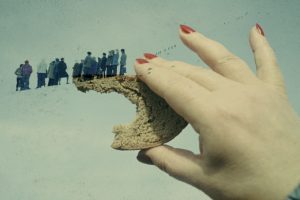
Boris Mikhailov, Untitled, from the series Yesterday’s Sandwich, 1966–1968
For queries, please write to us at ssaf.kasauliartproject@gmail.com